WEBINAR
Analytical Strategies for Diastereomers in Oligonucleotide Development
Explore why diastereomer distributions matter and how HPLC fingerprinting, ³¹P NMR and shortmer studies support their characterization and comparison.

Sharing our expertise
Explore expert perspectives on oligonucleotide manufacturing, regulatory considerations and bioanalysis.
WEBINAR
Explore why diastereomer distributions matter and how HPLC fingerprinting, ³¹P NMR and shortmer studies support their characterization and comparison.
WEBINAR
Case studies on guide RNA synthesis, cleavage and deprotection scale-up, HPLC purification control and API concentration. Explore process development approaches for clinical and commercial oligonucleotide manufacturing.
WEBINAR
Learn how BioSpring’s UF/DF method addresses oligonucleotide concentration limits before lyophilization and in solution API manufacturing.
WEBINAR
A CDMO perspective on molecule classification, process validation, release specifications and analytical method validation for Phase III and commercial oligonucleotide programs.
WHITEPAPER
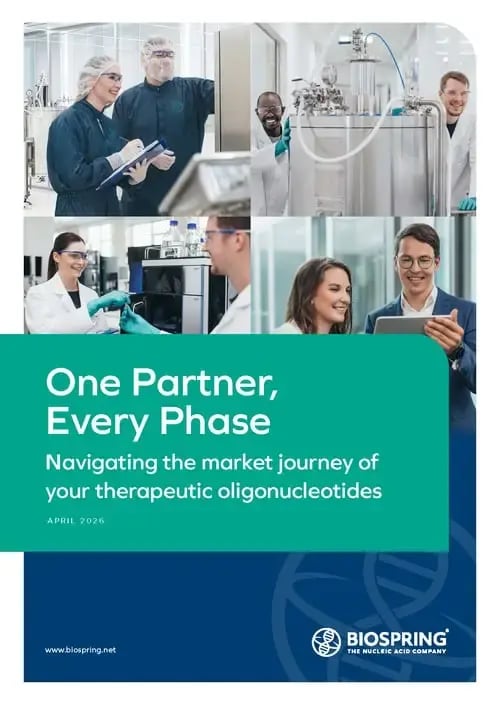
Navigating the market journey of your therapeutic oligonucleotides. Explore CDMO selection, technology transfer, analytical continuity and GMP readiness, with case studies from development through commercial supply.
WHITEPAPER
Six considerations for the transition to commercial supply: regulatory engagement, specifications and impurity control, early CDMO involvement, process characterization, scale-up and lifecycle management.
WHITEPAPER
Compare hELISA, qPCR and LC-MS/MS for oligonucleotide quantification in biofluids and tissues, and explore BioSpring’s LC-MS/MS approach using isobaric internal standards.

Phosphorothioate linkages are widely used in oligonucleotide therapeutics, but the resulting diastereomeric complexity presents important analytical and manufacturing considerations. This webinar explains why diastereomer distributions matter and introduces analytical approaches for their characterization, including HPLC fingerprinting, ³¹P NMR, and shortmer studies. Attendees will gain deeper insight into fingerprint methods and their application to the characterization and comparison of complex diastereomer mixtures.

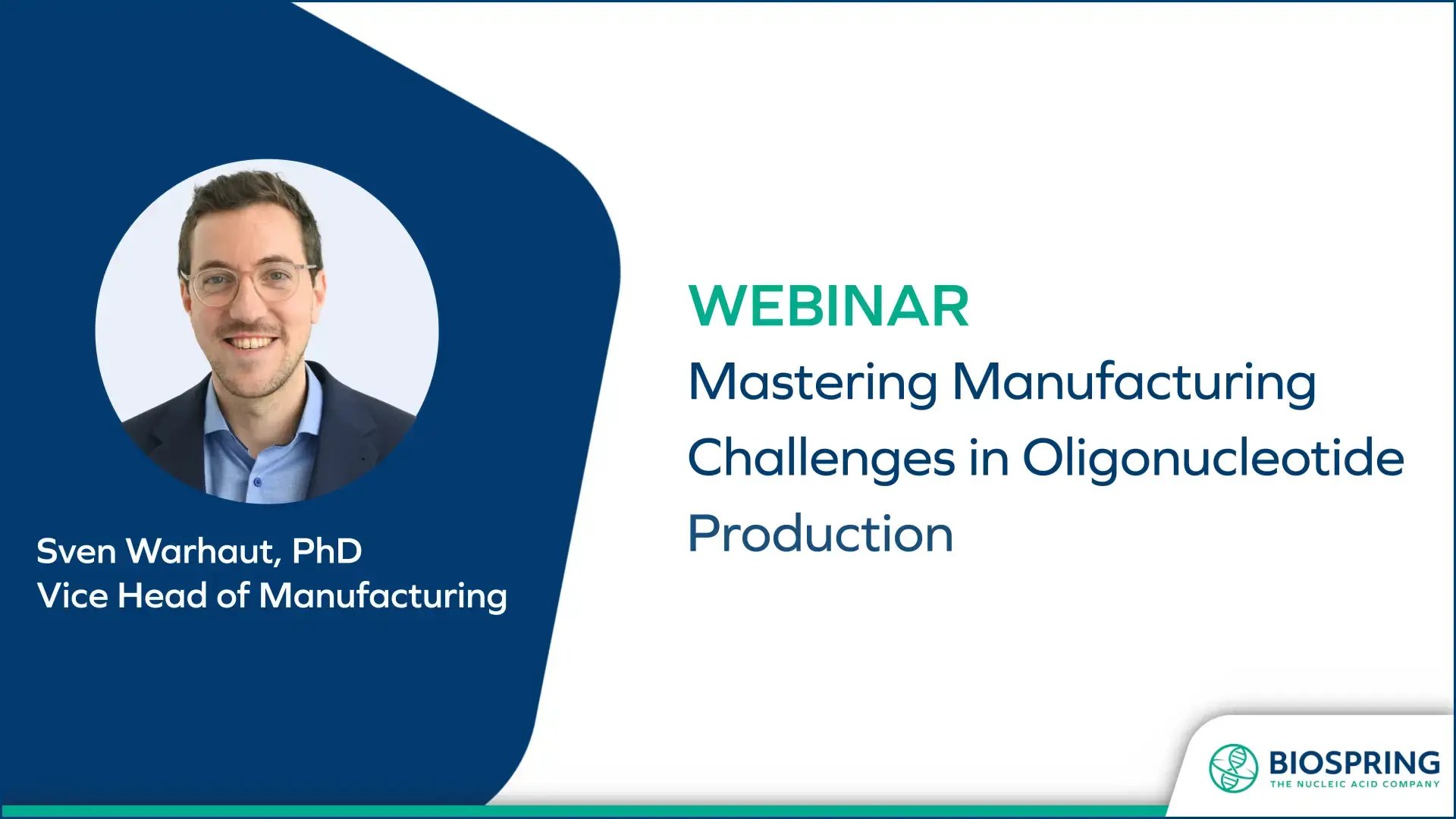
As oligonucleotide programs advance toward clinical and commercial supply, manufacturing processes must address increasing complexity across molecule types, modifications, and batch sizes. This expert presentation explores practical approaches to key manufacturing challenges in therapeutic oligonucleotide production, including guide RNA synthesis, cleavage and deprotection scale-up, stereoisomer control during HPLC purification, and API concentration before lyophilization or solution API manufacturing.
In this TIDES USA spotlight presentation, Sven Warhaut, Ph.D., shares BioSpring’s perspective on how targeted process development and manufacturing improvements can help support demanding oligonucleotide programs from early development through commercial supply. The presentation highlights selected case studies, including scalable guide RNA manufacturing, representative scale-down models for process development, analytical strategies for purification control, and osmolyte-assisted UF/DF for high-concentration API manufacturing.

Ultrafiltration is widely used in oligonucleotide manufacturing, particularly for the desalting and concentration of active pharmaceutical ingredients (APIs). With traditional ultrafiltration, the concentration that can be achieved is limited. This creates a significant bottleneck in the production of powdered APIs, where ultrafiltration is frequently used as a pre-lyophilization step and determines the maximum batch size that can be obtained with the freeze dryer capacity. Moreover, traditional ultrafiltration often cannot support the manufacturing of oligonucleotide solution APIs because it fails to exceed the concentration of subcutaneous drug products. To address these issues, BioSpring has developed an in-house ultrafiltration/diafiltration (UF/DF) technique, optimizing nucleic acid concentration and enhancing production efficiency.
.webp?width=1920&height=1080&name=Comp%202%202%20(1).webp)
Advancing an oligonucleotide therapeutic into late-stage development presents unique challenges, requiring a well-defined regulatory and validation strategy. This talk provides key insights from a CDMO perspective on molecule classification, process validation steps, regulatory expectations, and the role of release specifications. Additionally, it highlights best practices for analytical method validation tailored to Phase III and commercial programs, ensuring regulatory compliance and product success.
.webp?width=1920&height=1080&name=Comp%201%20(1).webp)
Whether you are advancing an oligonucleotide therapy from early development into the clinic, preparing for GMP manufacturing, planning a tech transfer, or building commercial supply, each phase brings critical decisions. Multiple vendors, changing manufacturing processes, evolving regulatory expectations, and inconsistent analytical methods can increase risk, add complexity, and delay progress.
This whitepaper explores how you can:
Taking an oligonucleotide therapy from clinical development to commercial supply is a critical transition. As programs move toward GMP oligonucleotide manufacturing at commercial scale, regulatory expectations intensify, quality requirements tighten, and reliable large-scale production becomes increasingly important. Decisions around specifications, impurity control, process validation, scale-up, and lifecycle management can directly affect time to market and long-term product success.
This guide highlights key considerations around:
Whether you are seeking regulatory approval, evaluating
drug metabolism, or planning your next clinical phase, it is
crucial to have reliable data when analyzing oligonucleotidebased drugs and their metabolites in biofluids and tissues.
Oligonucleotides like ASOs, siRNAs, and guide RNAs
bring unique challenges: diverse chemical modifications
and conjugations, complex degradation pathways, and
interfering sample background make standard bioanalytical
methods unreliable or insufficient. Accurate bioanalysis
requires tailored analytical strategies that account for this
complexity.
This paper explores how you can:
Discover more