.png?width=221&height=78&name=Header_Knowledge%20(1).png)
It's the people behind BioSpring who make the difference. Every team member brings unique experiences, skills, and perspectives that strengthen our company every day. Today’s spotlight is on Laura Steinhauer & Nils Schomann (Quality Managers Analytical Method Development).
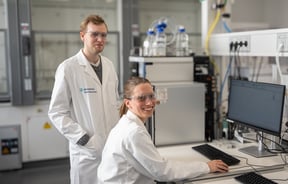
Laura and Nils are both part of BioSpring’s Method Development team. Nils joined BioSpring in 2021 and holds a Master of Science in Chemistry, bringing a strong scientific background to his role. Laura, a trained pharmacist, has been with BioSpring since 2023, following her practical pharmaceutical training. Together, they offer two different perspectives on the work behind method development at BioSpring.
What makes oligonucleotide analytical method development particularly challenging compared with more standard small molecule analytics?
The biggest challenge is that oligonucleotide impurities are very similar in structure to the full-length product. Often, they differ by only a single nucleotide or modification. As a result, standard separation methods can quickly reach their limits. It is precisely this low selectivity that makes method development for oligonucleotides challenging, but also especially exciting.
When you start developing a new purity-indicating method, what are the first things you look at?
First, we define the objective of the method — that is, which impurities are relevant and what level of separation is required. Based on this, we select the appropriate method type, such as IPRP/IPRP-MS, IEX, or SEC. We then establish basic method conditions such as the column and initial conditions, and begin a screening process to determine the method parameters. By utilizing our platform system, we can quickly and efficiently develop a robust, selective method.
How does BioSpring combine platform-based analytical development with molecule-specific optimization?
A common misconception is that we start further development with a pre-established platform method. In reality, we distinguish between platform methods and a platform-based development strategy. Where suitable, established platform methods can provide useful starting points, especially for selected molecule classes or early-stage analytical needs. However, platform methods can also quickly reach their limits, as each oligonucleotide reacts specifically to different eluent components. Consequently, even with method adjustments such as temperature or gradient, only insufficient improvements are achieved. Without an established strategy, finding the right components, their concentrations, and the method parameters built on them is very challenging. As a result, creating a truly customized, molecule-specific method with the best possible separation can be complex and time-consuming. For this reason, we have designed a platform-based development strategy that enables quickly determining these core parameters through efficient steps. In the end, AQbD helps adapt additional parameters, such as temperature, to the molecule and demonstrate the method’s robustness.
What typically separates an early-phase analytical method from one that is truly ready for late-stage or commercial validation?
In our approach, there is no fundamental difference in quality between early- and late-phase methods. All methods are designed from the outset to be effective in the long-term and to comply with analytical guidelines. This includes, among other things, the fact that they are designed to successfully pass GMP validation, which is essential for clinical and commercial studies.
The difference lies rather in the scope of the analysis: In the early phase, the focus is on a solid, fundamental control of the relevant impurities. As programs advance, these methods are not replaced but rather supplemented by additional, more specific methods to obtain an increasingly detailed and comprehensive analytical result.
What is one misconception clients sometimes have about analytical method development for oligonucleotides?
It’s the “egg-laying, wool-milk pig” — the German version of “jack of all trades,” and refers to a method capable of achieving everything at once: complete separation, MS compatibility, and sequencing capability, etc.
In practice, these goals require different physical and chemical conditions. That is why our focus is on combining several specialized methods to achieve the best possible analytical performance overall, rather than making insufficient compromises within a single method.
What do you find most rewarding about working in oligonucleotide analytics?
What we particularly appreciate is the variety and the technical challenges. Oligonucleotide analysis is a complex field in which it is necessary to continuously develop new solution approaches. At the same time, it is a very dynamic area of research with new findings and technologies regularly emerging. By incorporating these into our own work and developing reliable methods, we contribute to effective quality control of active ingredients, thus improving drug quality and patient safety.