.png?width=221&height=78&name=Header_Knowledge%20(1).png)
Every team member brings something unique to BioSpring. From diverse backgrounds and experiences to individual passions and expertise, it's the people behind the company who make the difference. Meet our colleagues and learn more about their role, journey, and life beyond the workplace. Today’s spotlight is on our process development leadership, Dr. Karin Zweig and Dr. Florian Schäfer.
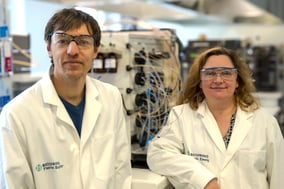 Dr. Karin Zweig is Head of Process Development at BioSpring and has been with the company for more than 20 years. She earned her PhD in nucleic acid chemistry from Goethe University Frankfurt and has played a key role in establishing the Process Development department at BioSpring in 2016. Prior to leading Process Development, she was responsible for small-scale, large-scale, and GMP manufacturing activities.
Dr. Florian Schäfer is a Team Lead Process Development at BioSpring with more than eight years of leadership experience in process development as well as small- and mid-scale nucleic acid manufacturing. Previously, he worked as a postdoctoral researcher and PhD candidate at Goethe University Frankfurt, where he earned his doctorate in chemistry with a focus on nucleic acid chemistry.
What surprised you most when you started out in oligonucleotide process development?
Karin: What surprised me most was how early you already need to think ahead toward large-scale manufacturing. Even in the earliest development stages, decisions on synthesis parameters, purification strategy, and process settings can strongly influence whether a process will later be scalable and robust enough for clinical and eventually commercial supply. In oligonucleotide manufacturing, “commercial thinking” is part of building the right process foundation from the very beginning, which might be even more relevant for oligonucleotides than for most other drug substance modalities.
What part of oligonucleotide process development still requires the most experience and judgement, even with strong platforms in place?
Florian: Balancing speed with robustness and transferability still requires the most judgement. With strong platforms, you can move fast, but the key is knowing when a process is robust enough to be scalable, not just “good in development.” Experience helps you decide what to optimize further and what to keep simple so the process remains reproducible and ready for later phases.
What was a particularly challenging process development project you worked on, and how did you navigate it?
Karin: It is not unusual for us at PD to face challenges, especially when it comes to new modifications, structures, or chemistry. For example, sequences with new or uncommon impurity patterns can lead to unexpected impurity patterns that require careful analysis and adjustment of process parameters. With our scientifically skilled and experienced team, we have been able to solve every challenge so far and enjoy working with our customers to find solutions.
Which other teams do you interact with most closely during process development?
Florian: The quality control teams, but especially Large-Scale Manufacturing. Collaboration with Large-Scale Manufacturing, particularly in the very early stages of projects, is essential for the successful transfer of processes to larger scales. In parallel, close interaction with Analytics/QC supports fast, data-driven decisions during development, especially when evaluating purity and impurity profiles. This combination helps ensure that development outcomes are not isolated lab results but a solid basis for scalable, reproducible manufacturing.
At what point do you start thinking about scalability and commercial manufacturing during process development, even in early programs?
Karin: From day one. In oligonucleotide process development, scalability is not a later consideration, it is a core design requirement. Synthesis parameters and purification concepts are developed with future transfer to large-scale manufacturing in mind, so that scale-up becomes a feasible and structured continuation of the process, not a re-development step. Economic factors, including material efficiency and process reproducibility, are therefore considered early to avoid costly adjustments during later scale-up.