
This month's perspective

Newsletter
BioSpring Update May 2026 - Manufacturing and analytics platforms in focus
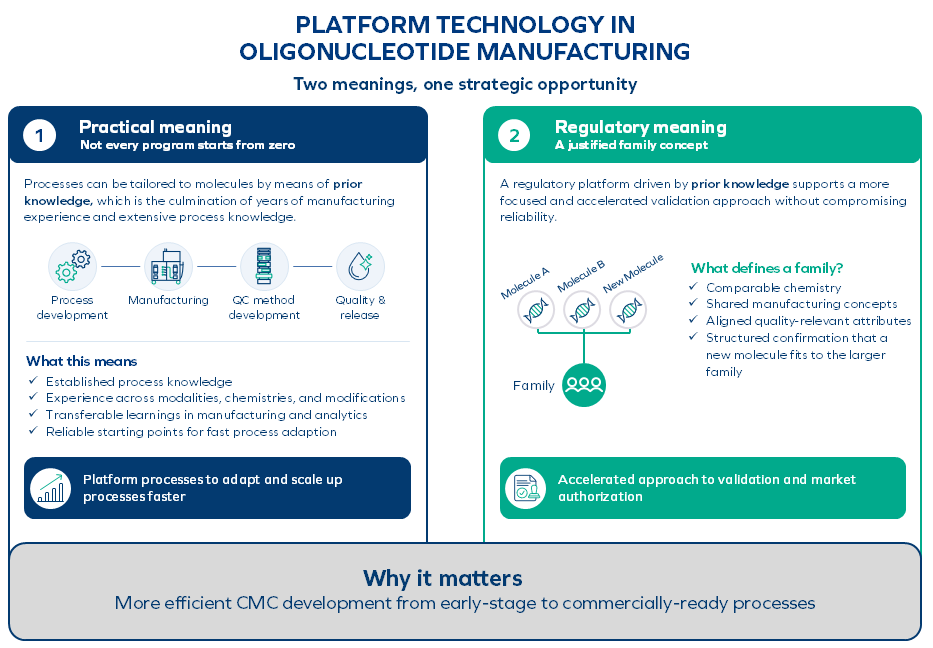
This month's service in focus
Platform-based analytical development and validation readiness for oligonucleotide programs
For therapeutic oligonucleotides, robust and high-resolution analytical methods are the foundation of reliable manufacturing, consistent supply, and confident regulatory interactions. In particular, purity-indicating methods, typically based on HPLC or LC-MS, are essential for assessing the purity of the full-length product and related impurities.
At BioSpring, we have a variety of established molecule-specific platform methods. While these methods can provide useful starting points for selected oligonucleotide classes and early-stage analytical needs, they rarely deliver the separation performance required for complex or highly modified sequences.
To achieve better performance, our analytical development strategy is built around true molecule-specific method development, rather than adaptation of a fixed universal method, which typically relies on predefined conditions with limited parameter adjustments. This means we develop dedicated HPLC- and LC-MS-based methods tailored to the specific sequence, chemistry, length, and impurity profile of each individual molecule. Our platform-based approach refers not to a fixed method itself, but to a highly structured and experience-driven development workflow that enables rapid and systematic identification of optimal separation conditions. Drawing on extensive expertise across all common oligonucleotide chemistries and modification types, we use comprehensive screening workflows on quaternary HPLC systems to evaluate buffer systems, amines, salt compositions, pH, temperature, gradients, and stationary phases in a targeted and efficient manner. This standardized screening approach enables rapid development of robust high-resolution methods tailored from scratch to each individual molecule.
Our focus is clear: achieving the best technically feasible separation of the full-length product and closely related impurities. This often means reliable separation and quantification of N-1 species or PO/PS variants. Within the boundaries for physicochemical separation of large molecules, we consistently maximize analytical resolution to support meaningful impurity control and reliable product characterization.
We develop each method with its entire life cycle in mind, including qualification and validation in accordance with ICH requirements. This includes an Analytical Quality by Design (AQbD) approach to assess at an early stage and systematically defined robust operating ranges for critical method parameters such as temperature and gradient slope. This results in a fit-for-purpose analytical method that reduces iteration cycles, increases method reliability, and provides a data-driven basis for regulatory discussions.
In addition to new method development, we support the optimization, transfer, and redesign of existing analytical procedures. Depending on program needs, we develop and adapt ion-pair reversed-phase (IPRP), IPRP-MS, ion-exchange (IEX), size-exclusion (SEC), and HILIC-based methods. Our expertise includes both denaturing and native duplex approaches, diastereomer separation strategies, mass-based quantification, identity testing, and orthogonal method concepts. Each analytical solution is selected and refined according to the specific molecular characteristics and the intended phase of development.
To learn more, contact us directly.
What you gain with BioSpring's platform-based HPLC analytics
Faster method development through platform knowledge
Structured screening strategies help identify effective conditions quickly, without compromising analytical power
Customer-molecule specific method design
Each sequence, length, and modification pattern receives a tailored HPLC approach, optimized for its individual impurity profile
High-resolution impurity separation
Focused on the best technically achievable resolution of full-length product, N-x variants, and critical PO/PS species.
Data-driven robustness through AQbD
Systematic evaluation of temperature, gradients, and critical parameters defines reliable operating ranges.
Validation- and QC-ready methods
Developed with ICH guidelines in mind are supporting cGMP measurements, validation and stability studies.
Lifecycle-oriented analytical support
From early development to commercial routine testing, our methods remain transferable and defensible aligned with evolving program needs.

Laura and Nils are both part of BioSpring’s Method Development team. Nils joined BioSpring in 2021 and holds a Master of Science in Chemistry, bringing a strong scientific background to his role. Laura, a trained pharmacist, has been with BioSpring since 2023, following her practical pharmaceutical training. Together, they offer two different perspectives on the work behind method development at BioSpring.
What makes oligonucleotide analytical method development particularly challenging compared with more standard small molecule analytics?
The biggest challenge is that oligonucleotide impurities are very similar in structure to the full-length product. Often, they differ by only a single nucleotide or modification. As a result, standard separation methods can quickly reach their limits. It is precisely this low selectivity that makes method development for oligonucleotides challenging, but also especially exciting.
When you start developing a new purity-indicating method, what are the first things you look at?
First, we define the objective of the method — that is, which impurities are relevant and what level of separation is required. Based on this, we select the appropriate method type, such as IPRP/IPRP-MS, IEX, or SEC. We then establish basic method conditions such as the column and initial conditions, and begin a screening process to determine the method parameters. By utilizing our platform system, we can quickly and efficiently develop a robust, selective method.
 How does BioSpring combine platform-based analytical development with molecule-specific optimization?
A common misconception is that we start further development with a pre-established platform method. In reality, we distinguish between platform methods and a platform-based development strategy. Where suitable, established platform methods can provide useful starting points, especially for selected molecule classes or early-stage analytical needs. However, platform methods can also quickly reach their limits, as each oligonucleotide reacts specifically to different eluent components. Consequently, even with method adjustments such as temperature or gradient, only insufficient improvements are achieved. Without an established strategy, finding the right components, their concentrations, and the method parameters built on them is very challenging. As a result, creating a truly customized, molecule-specific method with the best possible separation can be complex and time-consuming. For this reason, we have designed a platform-based development strategy that enables quickly determining these core parameters through efficient steps. In the end, AQbD helps adapt additional parameters, such as temperature, to the molecule and demonstrate the method’s robustness.
What typically separates an early-phase analytical method from one that is truly ready for late-stage or commercial validation?
In our approach, there is no fundamental difference in quality between early- and late-phase methods. All methods are designed from the outset to be effective in the long-term and to comply with analytical guidelines. This includes, among other things, the fact that they are designed to successfully pass GMP validation, which is essential for clinical and commercial studies.
The difference lies rather in the scope of the analysis: In the early phase, the focus is on a solid, fundamental control of the relevant impurities. As programs advance, these methods are not replaced but rather supplemented by additional, more specific methods to obtain an increasingly detailed and comprehensive analytical result.
What is one misconception clients sometimes have about analytical method development for oligonucleotides?
It’s the “egg-laying, wool-milk pig” — the German version of “jack of all trades,” and refers to a method capable of achieving everything at once: complete separation, MS compatibility, and sequencing capability, etc.
In practice, these goals require different physical and chemical conditions. That is why our focus is on combining several specialized methods to achieve the best possible analytical performance overall, rather than making insufficient compromises within a single method.
What do you find most rewarding about working in oligonucleotide analytics?
What we particularly appreciate is the variety and the technical challenges. Oligonucleotide analysis is a complex field in which it is necessary to continuously develop new solution approaches. At the same time, it is a very dynamic area of research with new findings and technologies regularly emerging. By incorporating these into our own work and developing reliable methods, we contribute to effective quality control of active ingredients, thus improving drug quality and patient safety.
.jpg?width=1200&length=1200&name=Image%20(9).jpg)
.jpg?width=1200&length=1200&name=Image%20(28).jpg)
.jpg?width=1200&length=1200&name=Image%20(18).jpg)
.jpg?width=1200&length=1200&name=Image%20(20).jpg)
.jpg?width=1200&length=1200&name=Image%20(12).jpg)

.png?width=1200&length=1200&name=Untitled%20design%20(5).png)
.jpeg?width=1200&length=1200&name=Image%20(1).jpeg)
.jpeg?width=1200&length=1200&name=Image%20(2).jpeg)
.jpeg?width=1200&length=1200&name=Image%20(3).jpeg)
.jpeg?width=1200&length=1200&name=Image%20(4).jpeg)


.jpeg?width=1200&length=1200&name=Image%20(10).jpeg)


.jpeg?width=1200&length=1200&name=Image%20(5).jpeg)

.jpeg?width=1200&length=1200&name=Image%20(9).jpeg)
.jpeg?width=1200&length=1200&name=Image%20(8).jpeg)
October 11 - 14, 2026 | Denver, Colorado, USA
No results found