4
Newsletter

February 2026

This month's perspective

Therapeutic Oligonucleotides: On the Rise and Moving Toward Broader Commercialization

DNA + RNA_V3


Therapeutic oligonucleotides have entered a new maturity phase. Considered “one of the fastest growing modalities” by Boston Consulting Group [1], ASO and siRNA medicines are firmly established as approved therapies while new oligonucleotide-based modalities are on the rise. The field is therefore increasingly shaped by how efficiently programs can be translated into scalable, reliable drug supply across development stages. [2] 

This momentum is also reflected in the broader RNA therapeutics landscape. Beacon’s RNA landscape review reports 5,554 RNA-based drugs tracked (preclinical and clinical) in its database as of July 2025, representing a 13% increase since the start of said year. [3] While this RNA-wide view spans multiple modalities under one umbrella, Beacon highlights a strong and diversified oligonucleotide preclinical pipeline as a major driver of sustained early-stage activity. Complementing this perspective, Citeline’s RNA pipeline tracking shows continued growth across RNA modalities from 2021 to mid-2025, with RNAi and antisense remaining among the most common therapeutic approaches. [4]

Looking ahead, the most important progress will likely be driven less by novelty and more by the ability to resolve well-known translational challenges while accommodating increasingly stringent regulatory requirements, e.g., regarding sequence identification and stereoisomers.

Other key topics include delivery beyond established target tissues (e.g., liver) and long-term tolerability under chronic dosing. Manufacturing and analytical strategies that scale smoothly from clinical to commercial supply remain critical, as demand forecasts for single products move into metric ton territory. [2,4] For many developers, these topics are now central to mitigate risks in their programs and build commercially viable pipelines. This is also where experienced external manufacturing and analytical capabilities can materially reduce development risk.

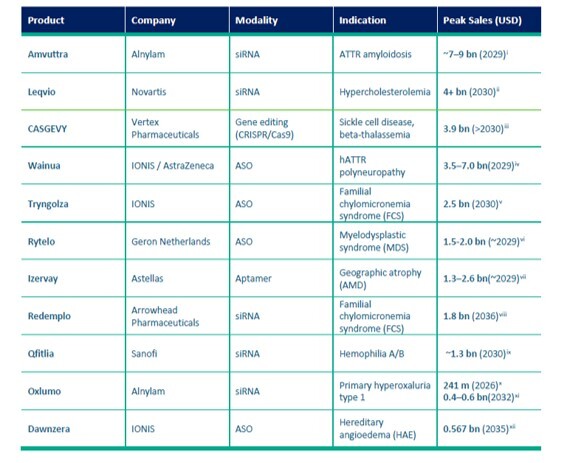
Against this backdrop, the commercial relevance of oligonucleotide therapeutics is becoming more tangible. Analyst forecasts for selected approved oligonucleotide drugs already point to substantial future peak sales (as shown in Table 1), underlining that commercial-scale supply is no longer a hypothetical scenario but an increasingly realistic requirement for successful programs. This is reflected in the growing oligonucleotide pipeline value as well, with CAGR averaging greater than 20% over the past five years. [1]

To summarize what we believe that means for developers:

  • Translation is the new battleground: delivery, tolerability, and scalable manufacturing becoming even more important than before. [1]
  • The pipeline is diversifying: more programs with diverse modalities, tackling a broader set of indications means more pressure on flexible, yet robust supply. [2,3]
  • CMC planning needs to start early: decisions around process design, analytical control, and scalability increasingly shape the path to commercial supply. [2]

References

[1] Lu Chen, et al. (2025) New Drug Modalities 2025, Article in BCG Publications, Biopharma, published October 09, 2025

[2] Liu, Y. et al. (2025) Landscape of small nucleic acid therapeutics: moving from the bench to the clinic. Signal Transduction and Targeted Therapy, 10:73.

[3] Hanson Wade, Beacon Intelligence (2025) Beacon RNA H1 2025 Landscape Review Series. Data as of 10 July 2025 / published 31 July 2025.

[4] Citeline (a Norstella company) (2025) Gene, Cell, & RNA Therapy Landscape Report. July 2025 data.

This month's service in focus

Process Development for Oligonucleotide Manufacturing

For therapeutic oligonucleotides, process development is the step that determines whether a sequence can become a reliable manufacturing reality. In other words, it is where a robust, scalable manufacturing process is developed for your oligonucleotide candidate. For therapeutic oligonucleotides, this means translating their sequence into a well-understood, reproducible production process, fit for large-scale manufacturing and with the required quality for clinical supply, with commercialization already on our minds.

At BioSpring, process development can always be started immediately, with no lead-time. Our typical first step is the so-called "familiarization". Here, we evaluate sequence composition, chemistry, and modifications of your target molecule. This assessment is then applied to our established manufacturing platforms, focusing on the most important process parameters, e.g. starting materials, bed heights, flowrates, etc. This process enables a rapid yet systematic definition of suitable upstream and downstream processing steps, tailored to each molecule.

In essence, our platform process provides the reliable starting point for all process development work and is based on sophisticated know-how we acquired over three decades of manufacturing more than 100,000 oligonucleotides. It enables a robust baseline while still allowing for easy customization and targeted optimization where needed.

Process development at this stage is supported by purity-indicating analytical (HPLC-MS) methods that ensure sufficient resolution to draw first conclusions about molecule-specific characteristics and the purity/impurity profile. Though these analytical methods are usually further developed for better resolution later on, they do already allow targeted adjustment of key process parameters such as coupling times, temperatures, and buffer compositions to optimize the process with regards to yield, purity and robustness.

By combining platform know-how with molecule-specific optimization, we enable efficient and fast scale-up, reduce development risk, and create the foundation for long-term manufacturing performance.

To learn more, contact us directly. 

Our process development services support the efficient clinical progression and seamless upscaling of therapeutic oligonucleotide programs, including:

  • Structured process familiarization based on BioSpring’s platform technology, adapted to each molecule’s sequence 

  • Flexible adjustment of key process parameters such as coupling times and reaction conditions

  • Development of impurity-aware process strategies to support high full-length purity and robust recovery

  • Delivery of scalable, transferable processes ready for large-scale GMP manufacturing

identifier_left

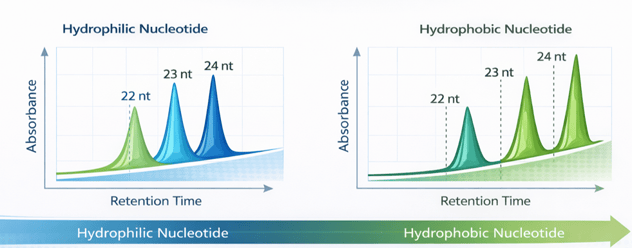
Reliable separation of full-length oligonucleotide therapeutics from closely related impurities remains a central challenge in downstream analytics. So BioSpring’s Saskia Schott, Nils Schomann and Michael Rühl teamed up with Waters’ Martin Gilar to systematically investigate how the intrinsic hydrophobicity of natural and chemically modified nucleotides influences chromatographic retention and resolution in ion-pair reversed-phase LC (IP-RP LC) and HILIC. Their results were published in the Journal of Chromatography A and have been cited 9 times already.

Using a comprehensive panel of 22–24 nt oligonucleotides carrying clinically relevant modifications (including 2-O-methyl, 2-fluoro, MOE, LNA, and phosphorothioates), the team showed that nucleotide-specific hydrophobicity directly affects both retention behavior and n/n−x separation selectivity. Importantly, they demonstrate how the choice of ion-pairing reagents can either amplify or suppress these effects, providing practical guidance for method development when dealing with heterogeneous or heavily modified sequences. 

 For analytical and QC teams, these insights translate into more predictable LC method design, improved impurity resolution, and a clearer rationale for selecting IP-RP LC versus HILIC depending on sequence composition and modification pattern. This supports robust impurity profiling, diastereomer assessment, and decision-making throughout development and manufacturing. 

Picture1_red

Figure 1: Conceptual illustration showing how nucleotide hydrophobicity influences n/n-1 separation in LC.

Reference: Gilar, Martin, et al., “Impact of Nucleotide Hydrophobicity on Oligonucleotides Separation in Liquid Chromatography,” Journal of Chromatography A, 1753 (2025), 465968, https://doi.org/10.1016/j.chroma.2025.465968.

To learn more, don't hesitate to contact us.


Get to know our experts

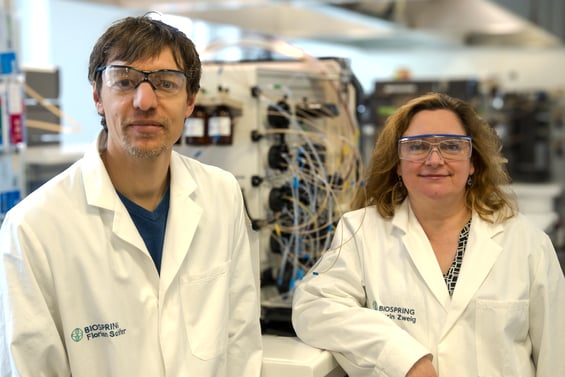
Dr. Karin Zweig (Head of Process Development) and
Dr. Florian Schäfer (Team Lead Process Development)

Today’s spotlight is on our process development leadership, Dr. Karin Zweig and Dr. Florian Schäfer.

Dr. Karin Zweig is Head of Process Development at BioSpring and has been with the company for more than 20 years. She earned her PhD in nucleic acid chemistry from Goethe University Frankfurt and has played a key role in establishing the Process Development department at BioSpring in 2016. Prior to leading Process Development, she was responsible for small-scale, large-scale, and GMP manufacturing activities.

Dr. Florian Schäfer is a Team Lead Process Development at BioSpring with more than eight years of leadership experience in process development as well as small- and mid-scale nucleic acid manufacturing. Previously, he worked as a postdoctoral researcher and PhD candidate at Goethe University Frankfurt, where he earned his doctorate in chemistry with a focus on nucleic acid chemistry.

What surprised you most when you started out in oligonucleotide process development?

Karin: What surprised me most was how early you already need to think ahead toward large-scale manufacturing. Even in the earliest development stages, decisions on synthesis parameters, purification strategy, and process settings can strongly influence whether a process will later be scalable and robustenough for clinical and eventually commercial supply. In oligonucleotide manufacturing, “commercial thinking” is part of building the right process foundation from the very beginning, which might be even more relevant for oligonucleotides than for most other drug substance modalities.Karin Zweig and Florian Schäfer
What part of oligonucleotide process development still requires the most experience and judgement, even with strong platforms in place?

Florian: Balancing speed with robustness and transferability still requires the most judgement. With strong platforms, you can move fast, but the key is knowing when a process is robust enough to be scalable, not just “good in development.” Experience helps you decide what to optimize further and what to keep simple so the process remains reproducible and ready for later phases.

What was a particularly challenging process development project you worked on, and how did you navigate it?

Karin: It is not unusual for us at PD to face challenges, especially when it comes to new modifications, structures, or chemistry. For example,  sequences with new or uncommon impurity patterns can lead to unexpected impurity patterns that require careful analysis and adjustment of process parameters. With our scientifically skilled and experienced team, we have been able to solve every challenge so far and enjoy working with our customers to find solutions.

Which other teams do you interact with most closely during process development?

Florian: The quality control teams, but especially Large-Scale Manufacturing. Collaboration with Large-Scale Manufacturing, particularly in the very early stages of projects, is essential for the successful transfer of processes to larger scales. In parallel, close interaction with Analytics/QC supports fast, data-driven decisions during development, especially when evaluating purity and impurity profiles. This combination helps ensure that development outcomes are not isolated lab results but a solid basis for scalable, reproducible manufacturing

At what point do you start thinking about scalability and commercial manufacturing during process development, even in early programs?

Karin: From day one. In oligonucleotide process development, scalability is nota later consideration, it is a core design requirement. Synthesis parameters and purification concepts are developed with future transfer to large-scale manufacturing in mind, so that scale-up becomes a feasible and structured continuation of the process, not a re-development step. Economic factors, including material efficiency and process reproducibility, are therefore considered early to avoid costly adjustments during later scale-up.


Image (9)
Image (28)
Image (18)
Image (20)
Image (12)

In case you missed it

Recent News

Joint Webinar with Dr. Michael Rühl on Streamlined Bioinformatic Tools for Oligonucleotide Characterization 

Michael_Headshot_clean_upscaled

In this joint webinar with Waters, we discussed how LC-MS workflows can support RNA characterization and quality analysis, complementing traditional and NGS sequencing approaches for critical quality attributes.  

Dr. Michael Rühl highlighted how streamlined bioinformatic workflows enable efficient sequence assignment based on MS data, including peak picking, deconvolution, theoretical mass calculation and peak-to-sequence matching. Using practical examples for sgRNA and mRNA, he illustrated how optimized enzymatic digestion strategies and theoretical sequence maps can improve sequence coverage while reducing experimental effort. 

Watch here:https://event.on24.com/wcc/r/5165871/9AACDAC07AB502042AB6F0F3826A485C?partnerref=linkedin


Welcoming Spring and Oligonucleotide Science at the CRISPR MEDiCiNE Conference, TIDES USA, and ASGCT Annual Meeting! 

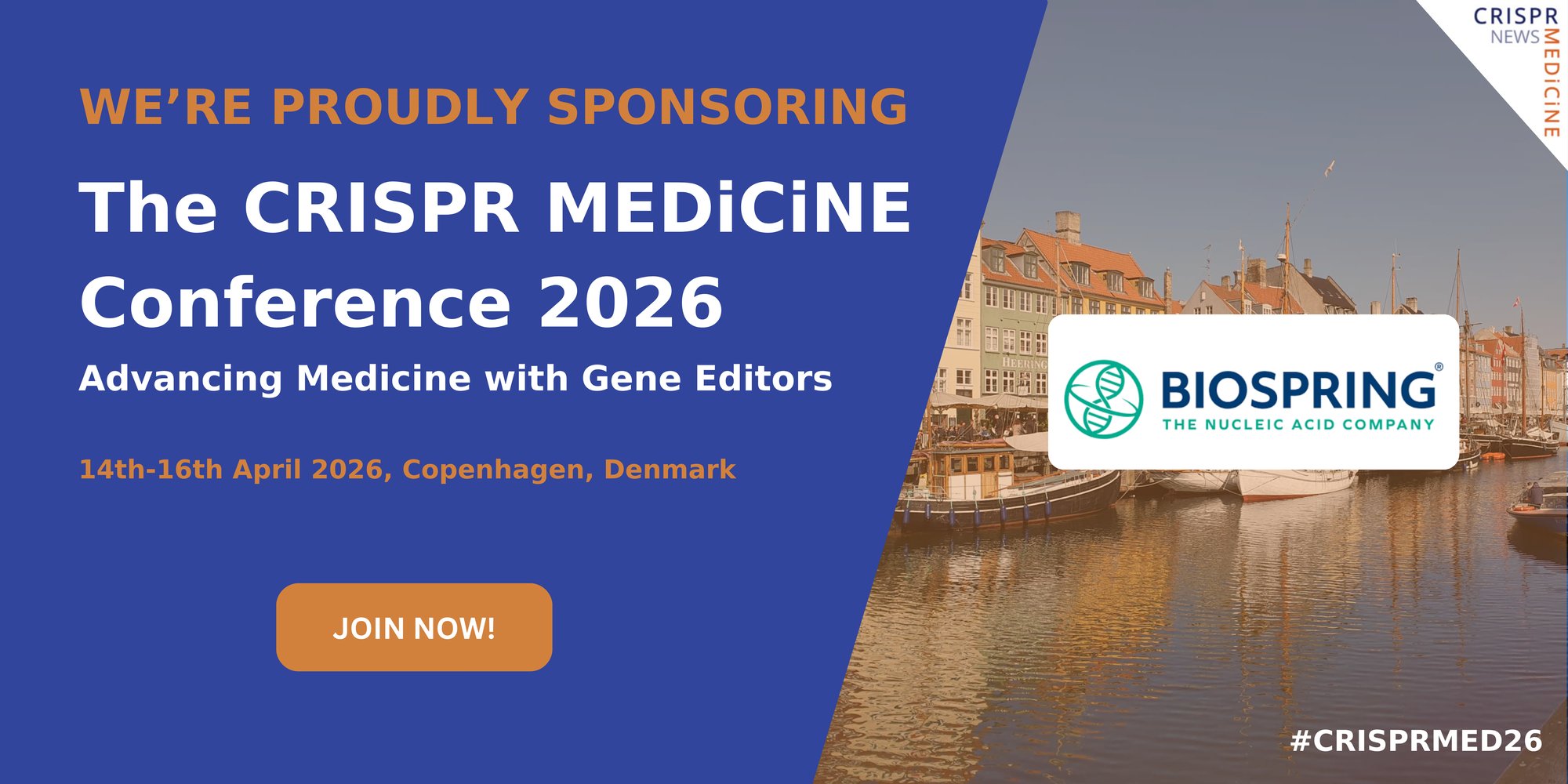
We’re headed to the 3rd CRISPR MEDiCiNE Conference in Copenhagen! Stop by Booth A‑3 to connect with the BioSpring team and explore our guide RNA and mRNA manufacturing and analytical services for research and commercial applications. Don’t miss Dr. Mathias Bolz, Project Lead GMP and Large Scale Production, as he presents his talk on “Redefining Long guide RNA Manufacturing with INFINIGuide” where he’ll share insights on our INFINIGuide platform, highlight advances in process robustness, and discuss approaches to support the development of guide RNAs with diverse length and design requirements.

Dates: April 13-16 

Location: Øksnehallen in Copenhagen, Denmark 

BioSpring's booth: A-3 

Sponsor Banner - Biospring

We look forward to TIDES USA, the oligonucleotide therapeutics conference of the year! We invite you to stop by our booth to connect with the BioSpring team and grab some goodies and our latest T-shirt.

This year we are excited to welcome clients, partners, and other industry leaders to our (Bio)Spring Fest! Paying tribute to BioSpring’s heritage this Oktoberfest-inspired celebration will take place at the iconic Sam Adams Downtown Taproom, steps away from Faneuil Hall. Join us for an evening of live music, refreshing beer, delicious food, and networking on Tuesday, May 12th! 

Dates: May 11-14 

Location: Hynes Convention Center in Boston, MA 

BioSpring's booth: 215 


Going to ASGCT? Visit our booth! If you’re attending, we’d love to meet you. We’re excited to explore what’s next in the cell and gene therapy space. At ASGCT, we’ll be highlighting our guide RNA and mRNA manufacturing services, supported by comprehensive analytical services, and look forward to engaging with innovators and drug developers shaping the future of genome editing. Curious about INFINIguide? Stop by our booth to learn more about how we’re pushing the boundaries of long RNA manufacturing.

Dates: May 11-15 

Location: Thomas M. Menino Convention & Exhibition Center in Boston, MA 

BioSpring's booth: 1083 


Whether you're looking for details on manufacturinganalytics, or our integrated services, our updated site helps you get the right information quickly and effortlessly.

Where to find us next

Upcoming Events

  • All
  • booth
  • attending
  • talk

March 17 - 19, 2026 | Austria, Vienna

March 18 - 19, 2026 | Boston, Massachusetts

April 14 - 16, 2026 | Copenhagen, Denmark

May 11 - 14, 2026 | Boston, Massachusetts

No results found

jPList Actions